 Thermal Technologies
Product family
Thermocouples and Temperature Sensors
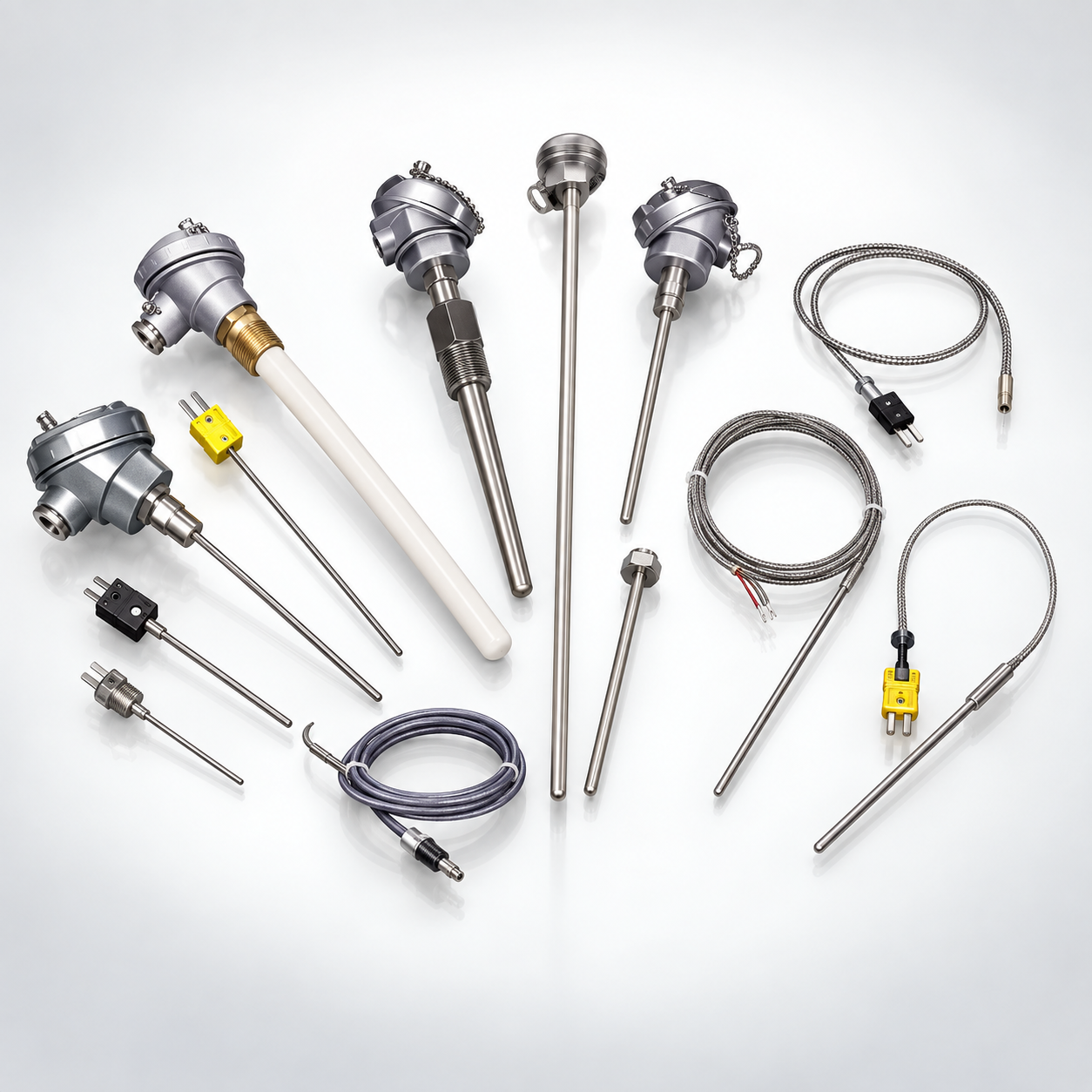
The measuring half of the job. Nine thermocouple types and PT100, PT500 and PT1000 RTDs, made to the immersion length, junction and connection your controller expects. Nothing is held in stock: every sensor is made against the order.
- 1 to 21 mmSheath diameter
- 20 to 2000 mmImmersion length
- 9 types, PT100 to PT1000Types offered
- Class 1 and Class ATolerance class
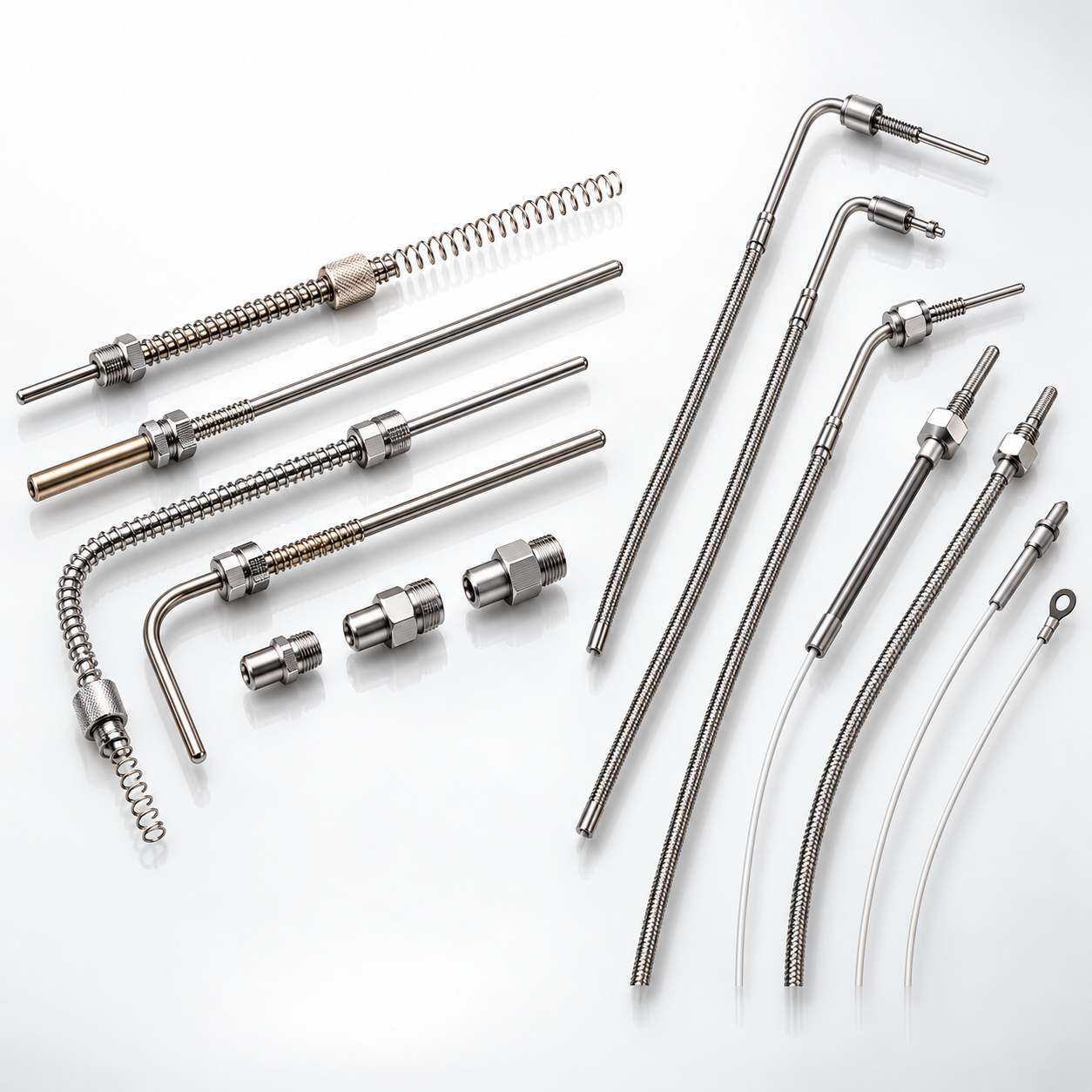
How it is built, and why that matters
A thermocouple is two dissimilar wires joined at one end. The junction produces a small voltage that varies with temperature, and the controller reads that voltage. Everything else, the sheath, the insulation, the cable, exists to get that junction to the right place and keep it there.
An RTD works differently. A platinum element changes resistance with temperature in a way that is very repeatable, which is why PT100 is the usual choice where accuracy and stability matter more than range or speed.
The junction arrangement is the decision that changes the behaviour. Grounded to the sheath is fastest but electrically connected to the process. Ungrounded is isolated and slower. Exposed is fastest of all and has no protection at all.
Where this family sits on temperature
- 0
- 300
- 600
- 900
- 1200 °C
The upper limit is Swiftheat's confirmed rating from the specification table below. The lower end is indicative for this element type.
Technical data
| Property | Thermocouple | RTD |
|---|---|---|
| Types offered | J, K, N, T, E, R, S, B, C | PT100, PT500, PT1000 |
| Useful range | 0 to 1200 °C | -200 to +300 °C |
| Tolerance class | Class 1 | Class A |
| Calibration | 100 percent, certificate on request | 100 percent, certificate on request |
| Sheath diameters | 1 to 21 mm | 3.5 to 21 mm |
| Supply | Made to order, none held in stock | Made to order, none held in stock |
| Immersion length range | 20 to 2000 mm | 20 to 2000 mm |
| Cable length range | 100 to 10000 mm | 100 to 10000 mm |
| Junction arrangements | Grounded, ungrounded, exposed | Not applicable |
| Connections | Plug, bare tails, terminal head | Plug, bare tails, terminal head |
| Terminals | PVC pin, round lug, fork | PVC pin, round lug, fork |
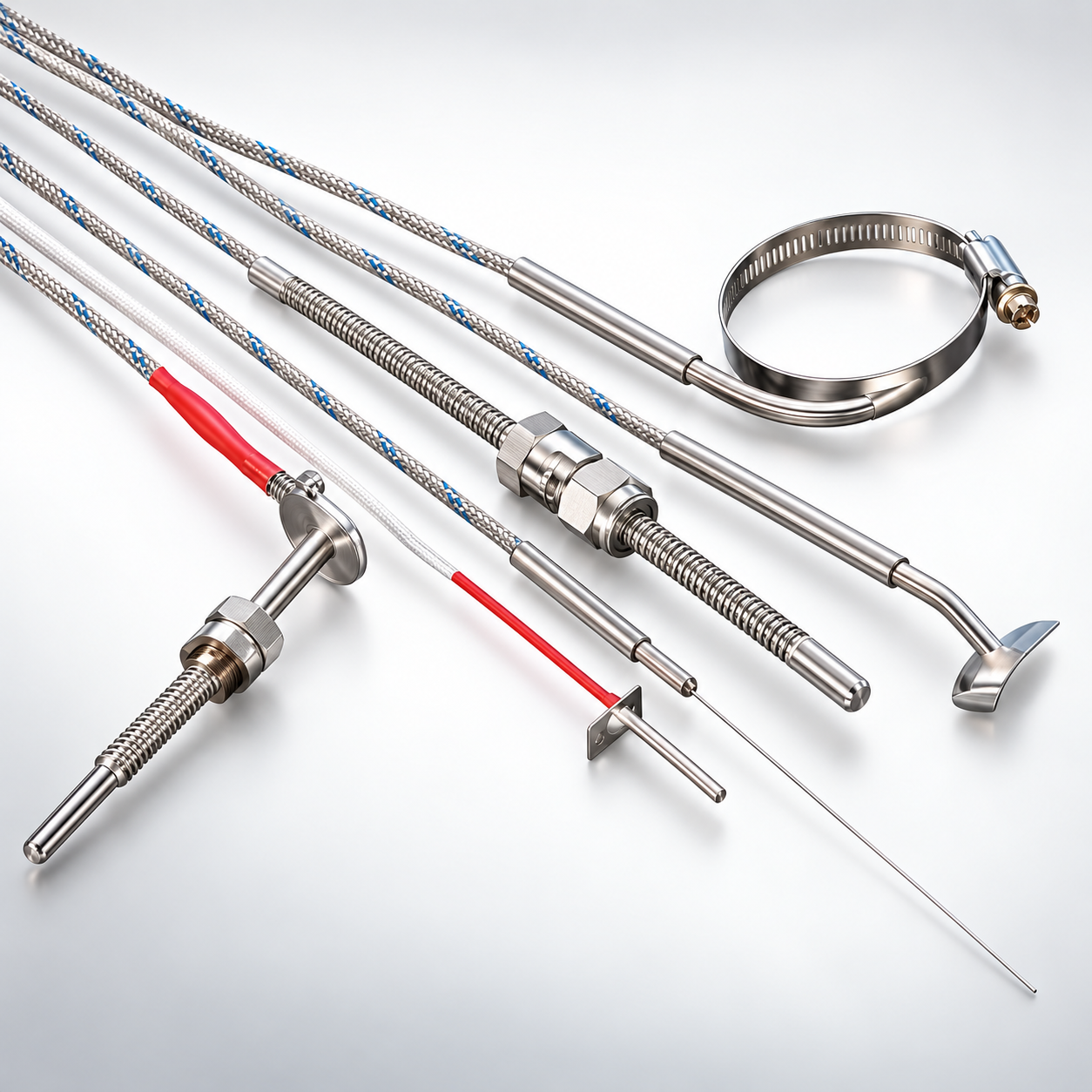
| Washer style | OD 8 to 16 mm, bolt M3 to M10, 3 to 6 mm thick | OD 8 to 16 mm, bolt M3 to M10, 3 to 6 mm thick |
| Lug style | OD 8 to 20 mm, bolt M3 to M12, 0.5 to 3 mm thick | OD 8 to 20 mm, bolt M3 to M12, 0.5 to 3 mm thick |
| Bolt style, fixed or rotational | Standard thread sizes | Standard thread sizes |
| Spring loaded style | Bayonet ID 11 to 18 mm, spring 100 to 1000 mm | Bayonet ID 11 to 18 mm, spring 100 to 1000 mm |
| Mineral insulated sheath | 1 to 8 mm | 3 to 8 mm |
| Manifold style | TEF-68, 4 mm diameter, 11 and 12 mm tip | Not applicable |
Dimensions
Every dimension we need in order to quote, named the same way on the drawing, in the table and in the enquiry form. A buyer should never have to guess what we call something.
| Dimension | Symbol | Note |
|---|---|---|
| Sheath diameter | D | Made to the diameter required |
| Immersion length | L | Tip to the underside of the fitting |
| Cable length | CL | Tail or lead |
| Process thread | - | If a fitting or compression gland is required |
| Spring loading | - | For bayonet and spring loaded styles |
Key. D sheath diameter, L immersion length, CL cable length
Options
Everything you can order, given a code, a description and a rating. No Indian heater manufacturer publishes this today. It is what turns a quotation phone call into a part number, and every code here is the code that appears on your requirement document.
01 Type
- J
Type J thermocouple
Iron constantan. The plastics industry default.
- K
Type K thermocouple
Nickel chromium. Wider range than Type J.
- PT1
PT100 RTD
Platinum, 100 ohm at 0 degrees C. Highest stability.
- PT5
PT500 RTD
Platinum, 500 ohm at 0 degrees C.
- PT10
PT1000 RTD
Platinum, 1000 ohm at 0 degrees C.
02 Junction
- G
Grounded
Bonded to the sheath. Fastest of the protected types.
- U
Ungrounded
Electrically isolated from the sheath.
- E
Exposed
No sheath at the tip. Fastest, and unprotected.
03 Connection
- P
Plug
Standard miniature or flat pin plug.
- B
Bare tails
Stripped and tinned tails.
- H
Terminal head
Cast head with a terminal block.
Nothing is held in stock. Every sensor is made against the order. The coded list above is the part the requirement builder covers. Types N, T, E, R, S, B and C are made alongside them, as are washer, lug, bolt, spring loaded, mineral insulated and manifold styles, compression fittings, bulkheads, NPT and BSP bushes, connectors and extension cable. Continuous limits by lead insulation: Teflon 270 C, fibreglass 450 C, ceramic 900 to 1000 C, and mineral insulated sensors run to 1200 to 1400 C. State the controller make and model if you want us to match an existing sensor.
Choosing the right sensor
Match the type to the controller
A Type K sensor read by a controller set to Type J is wrong at every temperature, and it is a surprisingly common fault on a production line. State what the controller is set to.
Isolate where there is electrical noise
An ungrounded junction breaks the electrical path between the process and the controller input, which is worth having on a machine with drives and solid state relays.
Immersion length is measured, not guessed
A sensor that stops short of the melt reads the steel around it. Measure from the seating face to where the tip has to sit.
| Type | Short term | Continuous | Class 1 | Class 2 | Class 3 |
|---|---|---|---|---|---|
| Type E | -40 to +900 °C | 0 to +800 °C | -40 to +800 °C | -40 to +900 °C | -200 to +40 °C |
| Type J | -180 to +800 °C | 0 to +750 °C | -40 to +750 °C | -40 to +750 °C | Not applicable |
| Type K | -180 to +1300 °C | 0 to +1100 °C | -40 to +1000 °C | -40 to +1200 °C | -200 to +40 °C |
| Type N | -270 to +1300 °C | 0 to +1100 °C | -40 to +1000 °C | -40 to +1200 °C | -200 to +40 °C |
| Type R | -50 to +1700 °C | 0 to +1600 °C | 0 to +1600 °C | 0 to +1600 °C | Not applicable |
| Type S | -50 to +1750 °C | 0 to +1600 °C | 0 to +1600 °C | 0 to +1600 °C | Not applicable |
| Type T | -250 to +400 °C | -185 to +300 °C | -40 to +350 °C | -40 to +350 °C | -200 to +40 °C |
| Type B | 0 to +1820 °C | +200 to +1700 °C | Not applicable | +600 to +1700 °C | +600 to +1700 °C |
Why these fail early
Telling a buyer how a product fails is the most credible thing a manufacturer can publish, and it is the fastest way to stop the same failure arriving twice.
- Wrong type for the controllerThe reading is plausible and wrong, so nobody questions it.
- Insufficient immersionThe sensor reads the fitting, not the process.
- Cable run beside power cablesInduced noise on a millivolt signal.
- Extension cable of the wrong typeCopper extension on a thermocouple circuit adds its own junction.
- Bent or crushed sheathThe junction moves, or the insulation resistance falls.
Where these are used
Each one links to the industry page, which shows the heating zones on the machine and the element type for each zone.
- Injection MouldingEvery zone on the machine, from the dryer to the mould, with the element type that suits it.
- ExtrusionBarrel, adapter and die head heating for pipe, profile, sheet and film lines.
- Blow MouldingPreform reheat, extrusion head and neck tooling heating for PET and extrusion blow lines.
- Packaging MachinerySealing bars, cutting and creasing tools, shrink tunnels and hot melt tanks.
- Die and MouldHot stamping dies, press platens and mould preheat, where the heater lives inside the tool.
- Food ProcessingTanks, sealing tools, dryers and jacketed lines, in plant that gets washed down.
- Pharmaceutical MachineryBlister and tube sealing, granulation drying, jacketed vessels and validated temperature measurement.
- Rubber and ElastomersCuring and vulcanising platens, extruder barrels and mould heating.
- Other Industrial HeatingOvens, tanks, ducts, pipes and surfaces, in plant that does not fit any of the categories above.
Related products
-
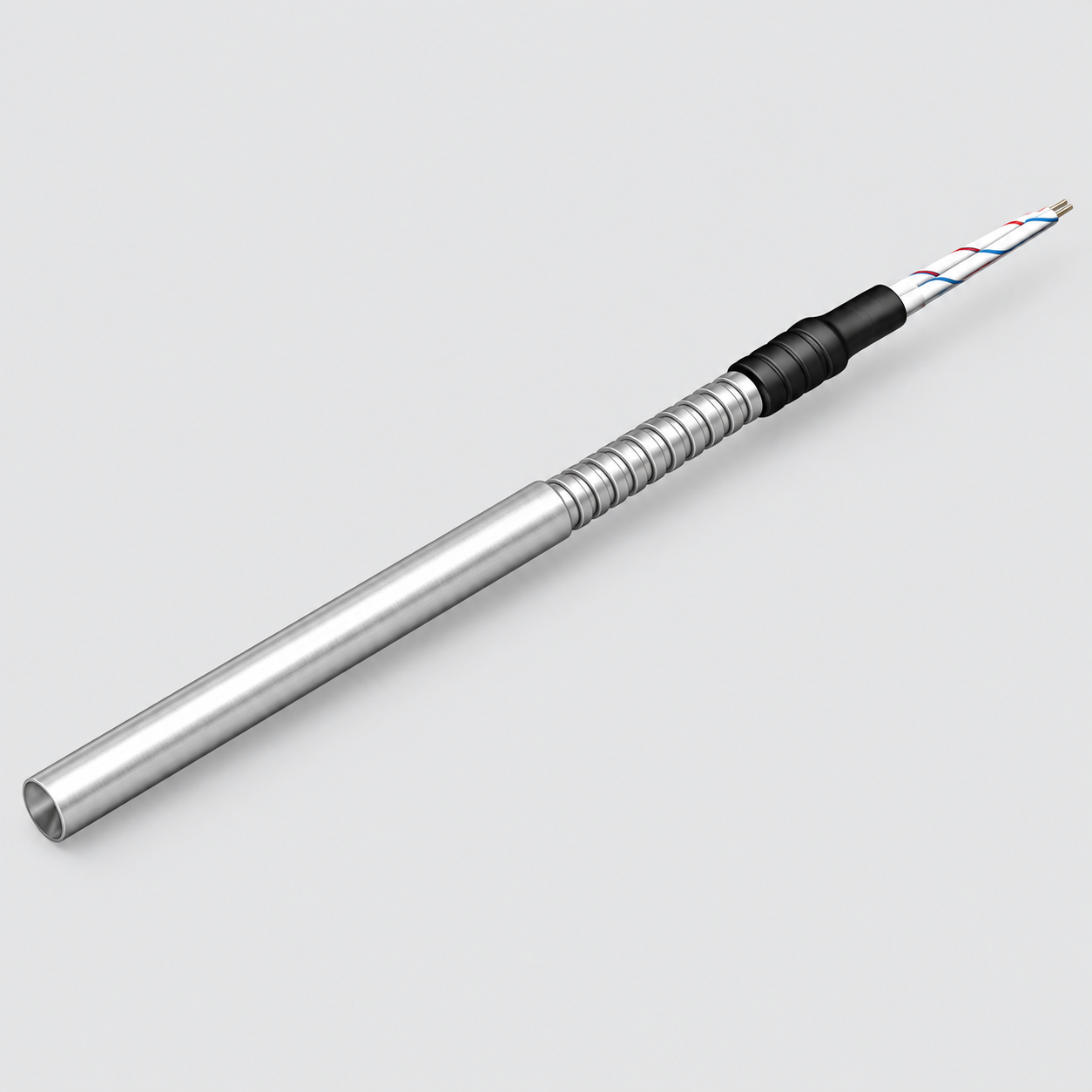 Cartridge Heaters
Bore mounted in moulds, platens and dies. Round, swaged, made to your length.
Cartridge Heaters
Bore mounted in moulds, platens and dies. Round, swaged, made to your length.
-
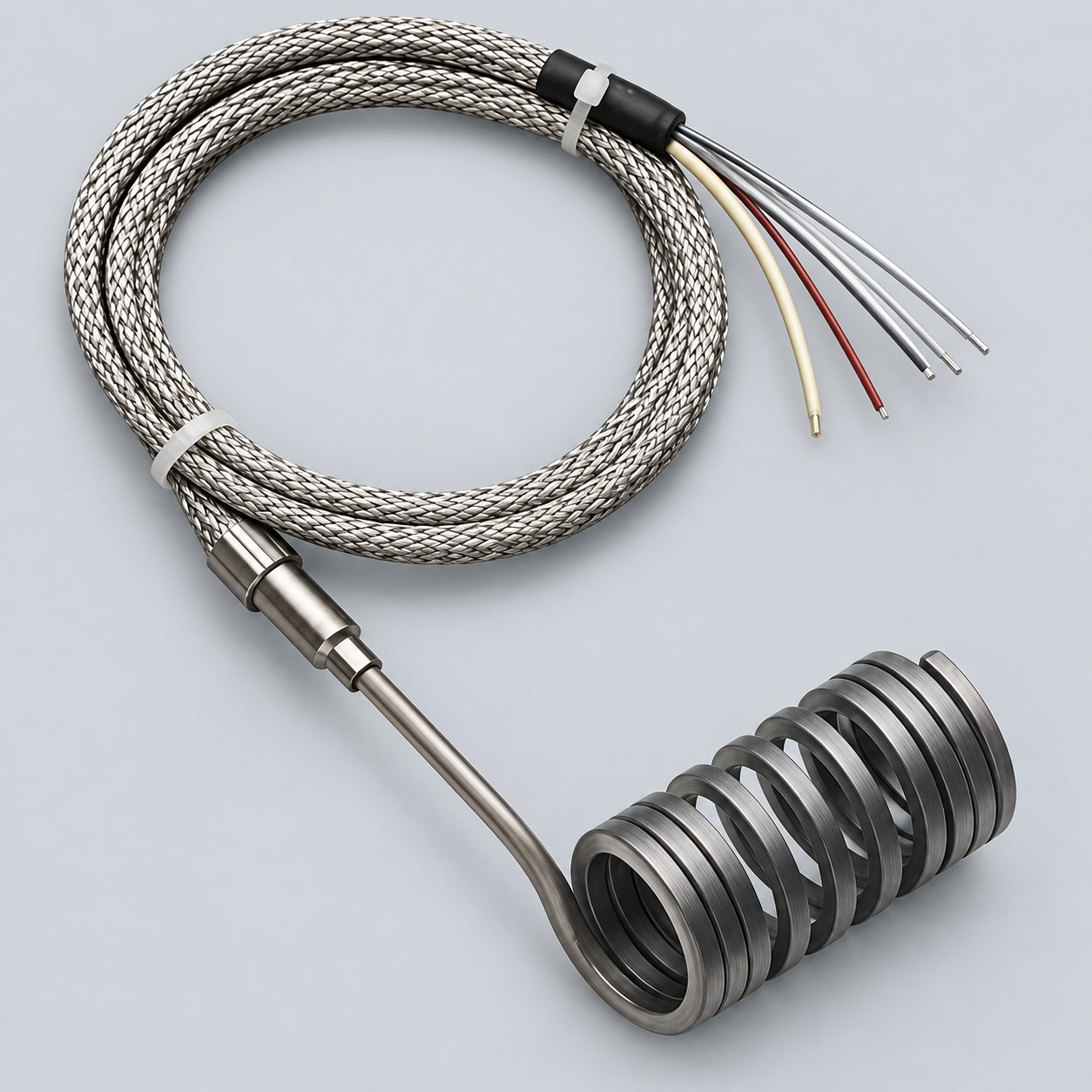 Coil Heaters
Hot runner nozzles and manifolds. Wound to the diameter, profiled along the length.
Coil Heaters
Hot runner nozzles and manifolds. Wound to the diameter, profiled along the length.
-
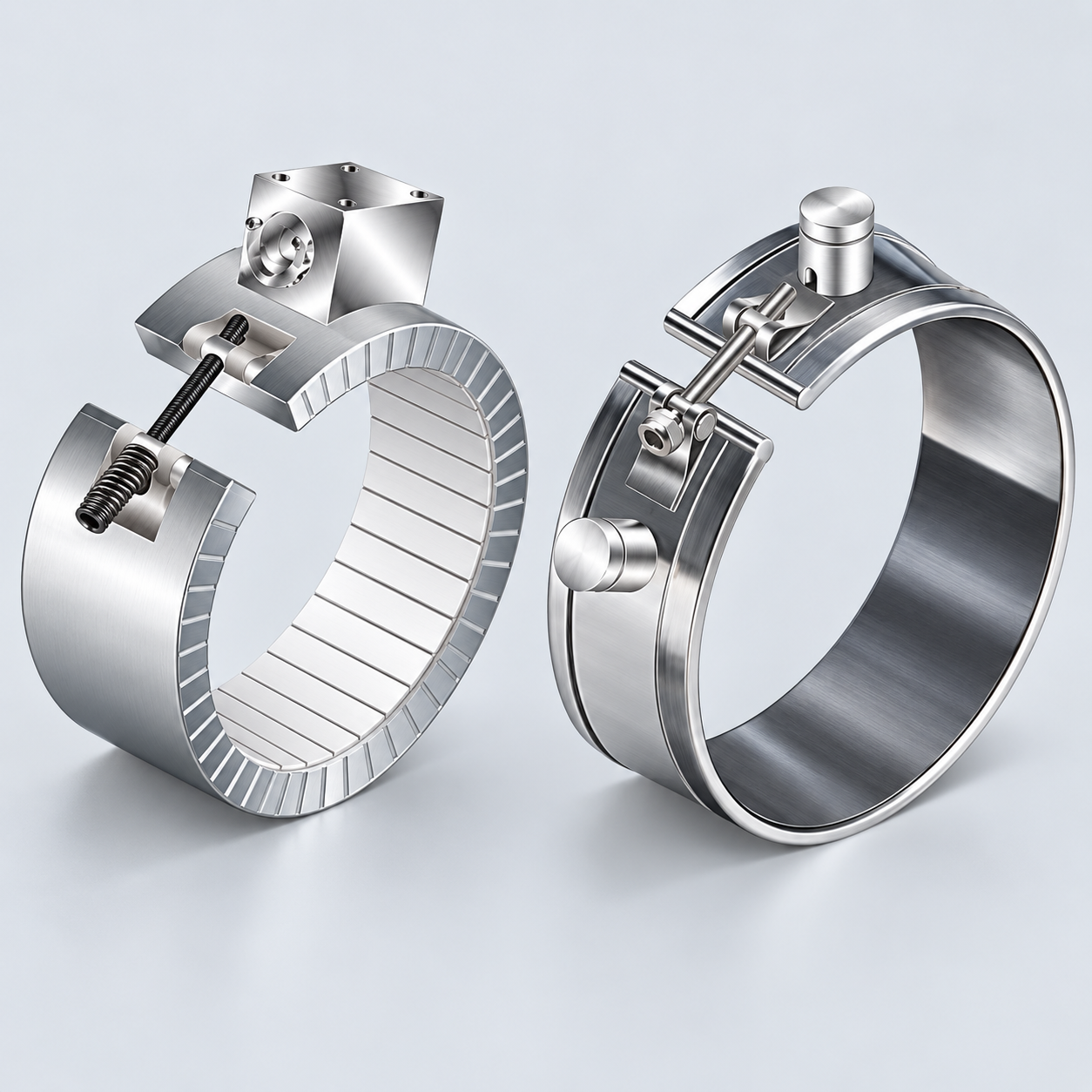 Ceramic and Mica Band and Nozzle Heaters
Barrels, cylinders, pipes and injection nozzles. One piece, split, expandable or partial coverage.
Ceramic and Mica Band and Nozzle Heaters
Barrels, cylinders, pipes and injection nozzles. One piece, split, expandable or partial coverage.
Request a quote for thermocouples and temperature sensors
Fill in what you know and leave the rest. The whole specification arrives at the works as a single readable email, and anything you leave blank our engineers will propose.